
Hiring the right people is the key
How to attract the best people you want to hire
I'm writing this while having a background in trying to solve hiring problems, so I might be a bit biased. However, this is NOT in any way related to trying to convince you that hiring is a problem that needs to be solved. It's more that I want to share my experience on how to attract the best people you want to hire.
Hiring in the tech world has gotten crazier these days, from people getting millions of dollars as signing bonuses to the amount of talent out there that cannot get an interview. Finding the right candidate can take A LONG LONG LONG TIME. In my experience, hiring the right people is what makes the difference between a team that executes and one that just talks about executing. There are several factors in the hiring process that "might" lead you to hire the best, and I'll be splitting them into sections to talk about each one separately.
Know who you want to hire
Before you start looking for people to hire, stop and ask yourself one question: do I actually know what I'm trying to build and do I know how to build it? I know it might seem obvious, but I think most hiring mistakes don't happen because of the interview process, or because the candidate isn't qualified. They mostly happen because you don't know why you hired this person! The clearer you are on both the "what" and the "how," the more precise your search becomes. The answer to these questions, I believe, must be rooted in the company's vision of what we want to build. I think doing something that isn't aligned with the vision won't lead to any outcome that can be considered great. You will face so many obstacles and so much resistance. I'm not saying it's impossible, but it will be more work on your plate. Thus, answering this question will guide your selection criteria by eliminating the candidates who won't help with that vision.
Before you write a single job description (which I think is useless), ask yourself one honest question: how well do I actually understand what I'm building? Your answer should shape everything about who you're looking for. I believe hiring must be aligned on what you are building.
I broke it down to this simple matrix:
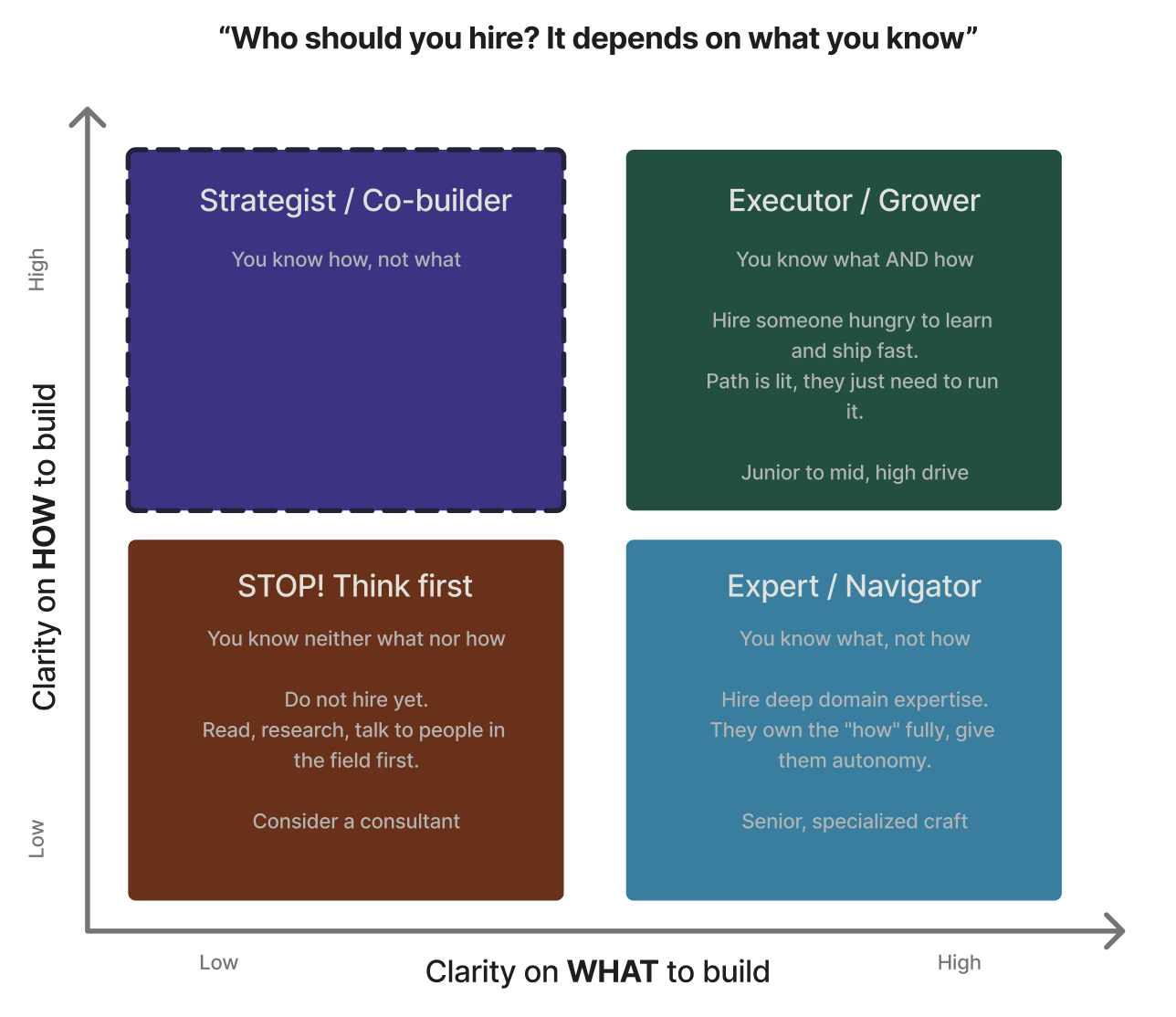
Let's say you want to start solving things you already know exactly how to build, but you don't have the time to build them yourself since you are working on more critical or higher-priority tasks. In that case, while you know exactly how to build such a thing, you need to start looking for people who are eager to learn and develop their skills. Since the solution, as you already know, is not vague and you know the steps to build it, it will give these people their own "fun" learning curve. I say "fun" because they should literally see the outcome within a very short period of time. Moreover, this would be a great opportunity to help them build their career and explore the field they are in. Which, in this case, would be at the top right (Executor / Grower). This is the best-case scenario, and a beautiful opportunity for both sides. Because the path is already lit, this person will see results quickly, and that early momentum builds confidence, ownership, and genuine career growth.
A couple of takeaways from this:
- Don't over-hire for this. You are better off being understaffed than hiring the wrong person.
- If you see yourself working in this area, PLEASE delegate! The person who is working on this should NOT be someone who requires a lot of your time, attention, and guidance. Your part here is to validate the work.
Let's take another example: you know what you want to build but you don't know how! It's completely outside of your expertise. Before doing anything, please read as much as possible about the new field. In that case, I think you need someone with more experience to start navigating through this new field and who can move quickly because of their accumulated knowledge. They must have enough expertise to make real decisions independently, because you genuinely can't guide them on the details, the only thing you can do is challenge them. This means you need to give them a high degree of autonomy, and that's uncomfortable if you're not used to it. This would be the bottom right of the matrix (Expert / Navigator).
A couple of takeaways from this:
- Make sure that person isn't heavily invested in a specific legacy stack or a single methodology. I tend to see a lot of specialists naturally resist moving away from approaches they've spent years perfecting (I tend to do this sometimes), and that resistance becomes a real problem when you need to pivot. You'll be telling them "here's the destination, you figure out the road," but if the destination changes, you need someone who can adapt, not someone whose entire value is locked in one approach.
- Because you can't fully evaluate their technical decisions, alignment becomes your main check. You want to make sure they're building what actually needs to be built — not something fancy, not something familiar, not something unnecessary. Asking simple, direct questions about their progress often reveals more than you'd expect: an overcomplicated approach, a misunderstanding of the problem, or a bottleneck they haven't flagged yet. Never feel embarrassed to ask a "stupid" question. Sometimes that's the one that cracks it open.
For the top left of the matrix I haven't encountered such a case, thus, I won't talk about it.
The formula is simple: the less you know about the "what" and the "how," the less ready you are to hire. Even if you have the budget, take the time to explore the space yourself first, talk to people, read, pay for consultancy if you need to. It won't be a quick or comfortable process, but it will save you from one of the most expensive mistakes you can make: hiring someone before you know what you actually needed. The right hire at the wrong moment of clarity is still the wrong hire.
Before going to the next section, there's another question that would be a good start even before you begin looking for people. Ask yourself, "Can they build a clear career path with this role?" If you cannot imagine building their career with you, please think more about the workload you have; maybe you want a freelancer or part-timer! Because when you need someone to help you with a specific project (or during peak times of the year and busy work), you don't want someone who does nothing for a long period of time; that would be just a waste of effort and money. And it might be something that holds you back from building great things. Because more people will introduce more problems (it's a fact not an opinion). And it's not fun to see the head count and you are enforced to layoff people! The industry is paying the price now for over hiring (yah AI isn't the reason, change my mind!).
Time
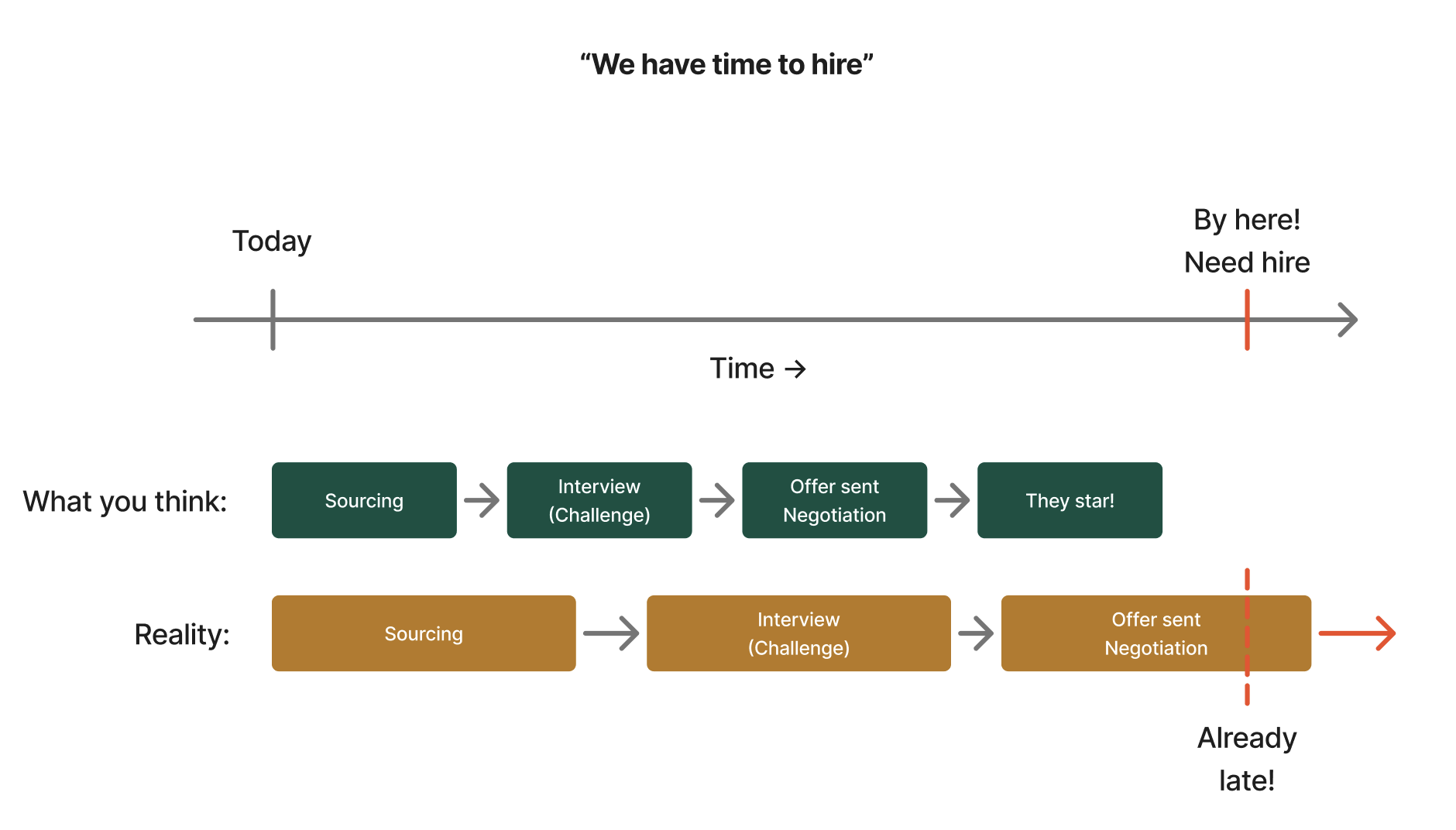
Every time you think, "We have time to hire", you're already late.
If you need someone in the next quarter and assume you have plenty of time, you're already behind! You are too busy with work and cannot take time to look into profiles, applicants, or even send messages to people you know about the vacancy. Sourcing (i.e., only finding a profile) a candidate that alone can take up most of your time, you don't want to settle for anyone that might be just a "good" fit. You've already defined who you want to hire, and based on those criteria, it might take FOREVER to find that person or you might not. The number of tailored CVs that seem perfectly fit for the role are endless, however, not all of them actually are. That sourcing process alone can take up 1/3 of the entire hiring journey.
Starting early will feel confusing because you'd think I have two weeks, that's enough! I thought something similar at the beginning. When I started hiring, I fell into the optimism trap. I assumed the timeline looked like this:
- I'd find the perfect match within the first 10 interviews (2–3 days).
- Then the interview process would take a week, depending on how many rounds there are and whether there's a challenge involved.
- After that, you'd send the offer thinking they'd respond within 2 or 3 days.
If that happens, believe me you are LUCKY.
Let's say you found the perfect profile and you want to reach out. This starts with a cold outreach, introducing yourself, the company, and the role, all within under 5 minutes. The goal is simply to gauge their interest and availability. At this stage, I'd recommend giving the candidate a clear picture of what to expect: the interview stages and some of the key areas you'll be covering, especially if there are theoretical questions they might want to brush up on. This gives them the best chance to perform well in the first interview.
After the first interview, you'll most likely give them a challenge. Here, you must accommodate their schedule, if they're currently employed, their time is limited, so ask them how long they need to complete it. At the same time, set your own maximum deadline for the task. This also gives you a strong signal of how they approach real-world problems. I highly recommend the technical challenge is nothing that take a long time to complete, if the candidate is senior they might just ghost you.
Now, let me take a detour to share a story about how unpredictable people can be and how the timeline that was set didn't go as I expected.
I was looking for an intern to join the data team, someone with a genuine interest in the field and a general overview of data science, engineering, and analytics. I got a recommendation to interview the candidate. The interview went well. The candidate showed great potential, and we decided to move forward. We sent the offer and expected them to start within three weeks.
During that time, we were working on our product roadmap, and the candidate was already factored in as a team member. Naturally, I stopped interviewing. The candidate was supposed to join the next month (probably a couple of weeks out). Fast forward to their start date! We got an email! Guess what? They decided not to join.
The problem wasn't that they didn't join — no, no, no, that happens. The real problem was that the roadmap had been built around them, and we couldn't afford to drop those features from the product.
Here's what I learned the hard way:
- Ask them if they're currently interviewing or considering other opportunities. Make it clear it's completely fine to change their mind, even after signing. The earlier you know, the better. This cost us dearly — you want to reduce that uncertainty as much as possible.
- Check in on them regularly, especially if their start date is far out and they need to serve a notice period. It helps surface any hesitation or second thoughts early.
- Keep the pipeline quietly running. Not full interviews — just stay aware of profiles, CVs, and people in your network. That way, if something falls through, you can move fast.
Where to look for?
When you're ready to source, it's easy to get overwhelmed by the endless sea of job boards and premium platforms. In my experience, you don't need a complex sourcing strategy. The best candidates consistently come from just three distinct places from my experience:
- People you know: Your absolute best bet is the network you've already built. These are the people
whose you know their work ethic, technical skills, and problem-solving approaches. Because there is already
established trust, the interviewing friction is minimal. Never hesitate to send a direct message them when a vacancy
opens up.
Disclaimer: They might be the hardest to convince - Friends of friends: If your direct network doesn't surface the right profile, expand it by exactly one degree of separation. Ask the people you already trust, "Who is the greatest engineer/data scientist you've ever worked with?" In my opinion, you might need to be more subtle on reaching out to them, keep it simple. Preferably if the person you know introduce you to him/her. This would make the hiring conversation must easier for you since you talked about what you do and they told you what they do. On top of that, you would be able to know them personally before the how they work to see if they are a good fit for the culture or not.
- Collage clubs: I think when you are looking for that top-right quadrant of the matrix (Executor / Grower) who is eager to learn and ready to build momentum. They usually have a billboard for job openings they share regularly.
During Hiring Process
You want them they don't need you
When you're a startup, the uncomfortable truth is that nobody cares about you! Nobody cares about your vision, your product, or your open role (at least not yet). The best candidates have options. They're being courted by companies with brand names, bigger checks, and more stability. So the moment you walk into a hiring process thinking they need us, and I'm better. you've already lost. Flip it! You want them. They don't need you. That mindset changes everything about how you recruit.
It's rare that someone would apply to an unknown startup working on something they're not personally interested in. So why does someone actually apply to your startup or another place in the first place?
1. Credential of the placeIf you genuinely believe candidates will join you because of how exceptional your engineering team is, or smart is your product team is. Let me be honest with you: nobody knows, and nobody cares. Not yet. Your company, no matter how good the work happening inside it, is invisible compared to the names people already have on their radar. The companies with millions of users, the ones whose names people say before they even know what the product does. You are not that. And that's completely fine.
The teams that people now fight to join were once exactly where you are unknown, unproven, and recruiting on belief rather than reputation. Not having that credential yet isn't a weakness in your pitch to the candidate. It's an amazing opportunity for the ones they want to be in it.
What's not fine is pretending otherwise. If you walk into a hiring process acting like your name carries weight it doesn't have yet, the candidates worth hiring will see through it immediately. The ones who don't are probably not the people you want building your foundation.
Some candidates will come to your process having spent time optimizing for big names on their CV. They'll talk fluently about what they've contributed, did several mock interviews, and endless case interviews. They are brilliant, but they are used to scale, infrastructure, and predictability. You have none of those. What you do have is raw ownership, urgency, and the rare chance to shape something from scratch. Don't sugarcoat this. Tell them honestly:
"We are not the most impressive line on your CV today. But if what we're building works, you'll have built it from the foundation. That is a entirely different kind of credential."
At the end, one of the best things I've read on early-stage hiring. Alex Wang blog post about how he hire. One line in particular has stayed with me:
One very scary thing to me is Scale becoming a credential rather than a cult. An institution like Harvard or MIT is a credential—people go there because it signals to others that the person is smart, capable, or otherwise prestigious. As an early stage startup, it's nearly impossible someone would join Scale for credentials—nobody knew who we were, nor did we have any reputation.
"A recruiting team that looks like a college admissions office is certain death for a startup."
At your stage, you cannot manufacture a credential. But you absolutely can build belief in the problem you're solving, in the way you work, in the people already on the team. That's your recruiting pitch. Not the name. The conviction.
2. To land a jobNot everyone who applies is chasing a mission in their career. Some people are simply looking for good, stable work, a role that pays well, doesn't consume their identity, and lets them be excellent at what they do without betting their career on a startup that might not exist in two years. That's a completely legitimate way to live and work, and it doesn't make someone a bad person or a weak candidate. But it probably makes them a bad fit for you right now.
At an early stage, you need people who treat ambiguity as something exciting rather than a friction.
The tricky part is that this is almost impossible to see directly. Rarely someone walks into an interview and says "honestly I just need a paycheck." Everyone performs enthusiasm. It's going to be a bit hard to know the one has this goal in mind or not. To bypass the rehearsed answers, knowing the candidate personally would be much easier.
3. They're drawn to what you're buildingThis is who you want. Unfortunately, it going to be rare to find this kind of candidate. These are people who looked at your company your mission, your product, your team and felt something. Curiosity, excitement, alignment. They won't apply most of the time, they will reach out to you!
At an early stage, this is your biggest recruiting asset. You can't compete on salary or brand. But you can offer ownership, learning, growth, meaning, and the rare chance to build something from scratch. The candidates who value that are self-selecting into your pipeline for the right reasons, and they'll stay when things get hard, because they were never just there for the paycheck.
A good signal to test this: ask them what they know about what you're building before you explain it. How much did they dig in on their own? Genuine interest leaves a trail.
Building trust is the thing during recruiting
Since you can't sell prestige or job security, what you can sell is clarity and trust. And that starts with how you communicate throughout the process.
Don't let a candidate feel like they dropped into your pipeline by accident. Tell them exactly why their specific profile stood out. Show them that their selection was deliberate. That alone separates you from the dozens of companies treating them as a new headcount with rigid hiring process or ghosting them or sending templated email.
The clearer and more honest you are about the stage you're at, the challenges ahead, what success looks like the more the right people will lean in, and the more the wrong ones will self-select out. Both outcomes are wins.
Small details matters A LOT
In this part, I'm talking about small details from the first interaction with a candidate until they join the team. Every person you hire will notice different things. One will care about the way you communicate. Another will care about details you'd never think to pay attention to, the tone of your rejection emails, how quickly you respond, or if you handed over the process to irrelevant recruiter. You can't predict which detail will matter to which person, so the only real strategy is to try making them all right. Small details compound. They're not decoration on top of your hiring process, they are your hiring process, as far as the candidate is concerned. Here are couple of things I noticed people would never care about that much, however they make a difference in the candidate's experience:
- OPEN THE CAMERA: It sounds obvious, but treat virtual interviews with the same respect as an in-person meeting. Eye contact and presence matter.
- Personalization in your communications: Anything you communicate from emails to calls until the face to face interview. Tell them you were impressed by their profiles, achievements, you heard good things about them, …, etc. Which in reality true, you didn't randomly selected a profile and thought "ok I'll try this one". If this is the case then technically you didn't do your job well. In general, mentioning their profile their achievements shows that you did your homework and made an effort to know them before reaching out to them.
- Build an intro setup: Dedicate the first few minutes of the call for setting up the board.
- Spend 2–3 minutes introducing yourself, your role, and your journey.
- Spend the next 2–3 minutes giving an abstract overview of the company, focusing heavily on the hard, unsolved problems your team is currently facing. Frame the role not as a list of responsibilities, but as a mission to solve those specific bottlenecks.
In the end, culture isn't written, it's hired
Your hiring process is your culture in high resolution. The way you source, the respect you show for a candidate's time, the honesty with which you discuss your flaws, and the intentionality of your communication are the exact traits that will define the engineering or data team you build.
Stop looking for perfect CVs on job boards, drop the corporate ego, and start looking for the people who want to run toward the chaos you are trying to solve. Scale will come later. For now, build belief.